
The Data-Action Gap in Retail

Kshitij Kumar
Chief Data and AI Officer

Retail has a strange problem in 2026.
Walk into the headquarters of almost any fashion retailer, beauty brand, or omnichannel commerce company, and you will find dashboards everywhere - Sell-through dashboards, Inventory dashboards, Customer dashboards, Pricing dashboards, Marketplace dashboards, Executive scorecards, and thats not all! Forecasting systems layered on top of reporting systems layered on top of spreadsheets built by operators who stopped trusting the systems years ago.
Yet, on Tuesday mornings across the industry, the actual decisions that move millions of dollars are still being made by humans manually stitching together fragmented signals. A planner has six tabs open; one dashboard shows last week’s sell-through, another tracks inbound inventory, there is a spreadsheet for store allocation, an email from the buyer asking why Store 47 is already out of size 8 while Store 23 is sitting on excess stock, and a vendor portal showing delayed replenishment timelines.
Did this sound familiar?
Every piece of data required to make the right decision already exists. None of them are connected to the decision itself. So, the planner does what retail operators have done for years: make the call using instinct, experience, partial data, and spreadsheet math.
That is the data-action gap.
It is the space between what retailers know and what their systems can do with that knowledge. And it is becoming a defining operational problem in modern retail.
Retail Solved Visibility. It Never Solved Action.
For more than two decades, retail technology investment has focused on one thing above all else: visibility. The industry built data warehouses, then lakes, then lakehouses. It deployed BI platforms across every department. Customer data platforms promised unified profiles. Forecasting tools promised predictive insight. ERP systems became more connected. POS systems became cloud-native. And dashboards multiplied.
Retailers now collect more information per SKU, per customer, and per transaction than at any point in history. But the core operational decisions remain surprisingly manual.
- What should we buy?
- How much inventory should move between stores this week?
- Which markdown should happen now versus later?
- Which customers should receive outreach today?
- Which stores are under-assorted by size?
- Which products are creating return risk before the returns even happen?
These are still largely human-driven workflows. The dashboard era solved visibility, not execution; that distinction matters. A dashboard is ultimately a translation layer between data and humans. It takes operational complexity and compresses it into charts, metrics, and summaries that a person can interpret. But every translation introduces latency. Every handoff loses granularity. And every additional system creates another layer between information and action.
The interesting question in retail is no longer: Can we see what is happening? Most retailers can.
The real question is: Why is a human still acting as the integration layer between sixteen disconnected systems?
Because that human becomes the bottleneck. Not because planners, buyers, allocators, or merchandisers lack expertise, quite the opposite; retail operations today depend on human judgment compensating for system fragmentation. The planner is not just planning. The planner is manually reconciling timing differences between systems, resolving contradictory signals, filtering irrelevant noise, prioritizing decisions under time pressure, and translating reporting outputs into operational actions.
In many organizations, the most important workflow is still: Export data → clean data → discuss data → decide manually
That is not an AI problem. It is an architecture problem.
Why the Data-Action Gap Persists?
If retailers have invested so heavily into data infrastructure, why does the gap still exist? Because most retail systems were designed to support reporting, accounting, and process compliance, not continuous operational decision-making.
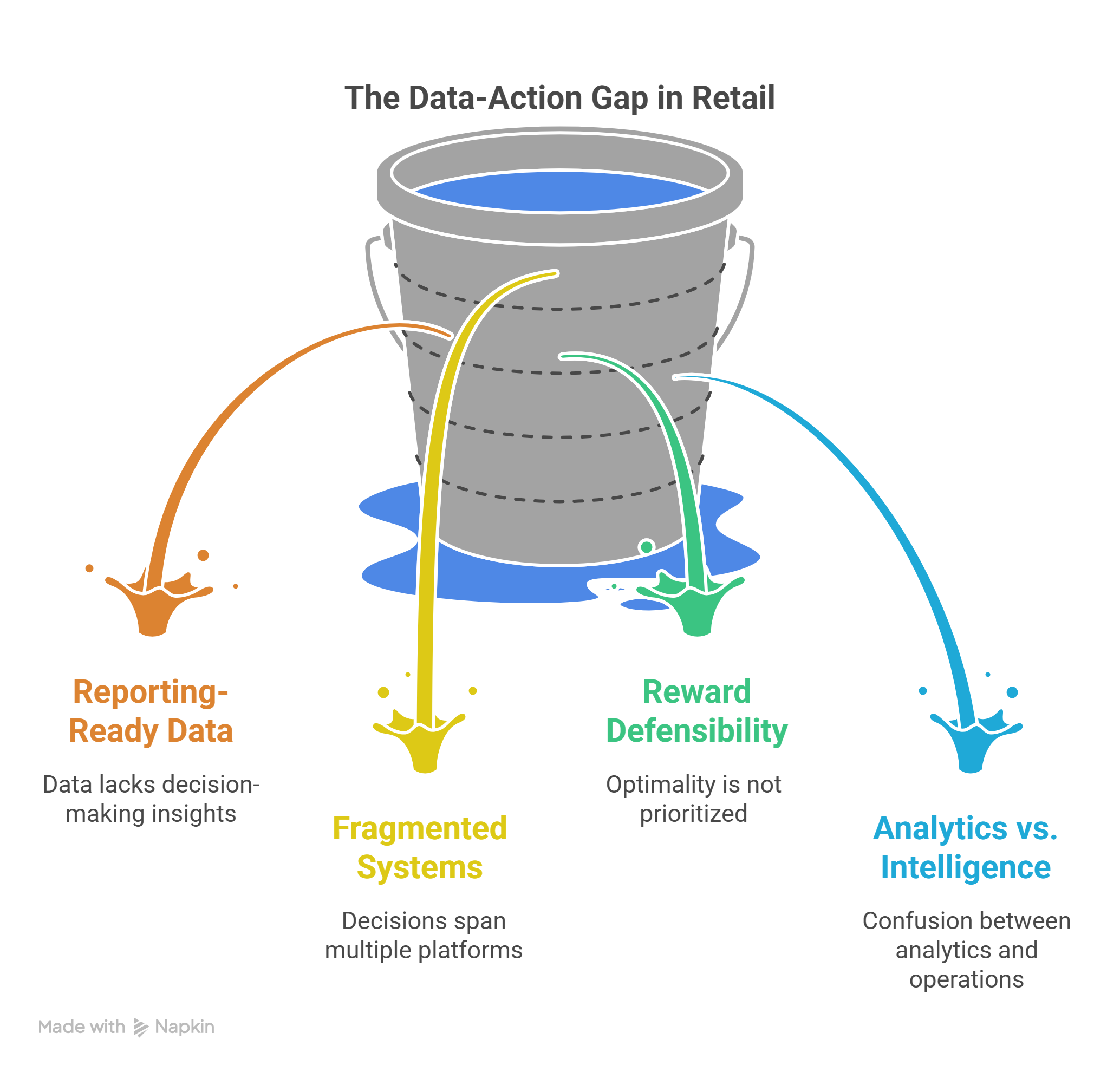
There are four structural reasons the gap persists.
1. Retail Data Is Reporting-Ready, Not Decision-Ready
Most retail data systems are optimized for explaining what already happened. They are far less capable of recommending what should happen next.
Take a weekly sell-through report. It might tell an allocator that a product is underperforming in one region and outperforming in another. Useful insight. But the operational decision is far more granular:
- Which specific style-store combinations should be rebalanced?
- How many units should move?
- Which transfers are economically viable?
- What happens if inventory arrives two days late?
- Should replenishment take priority over transfer?
- Should markdown timing change first?
The report rarely answers those questions directly. Because the granularity, freshness, and structure of the data were never designed around the actual decision surface.
Most enterprise retail systems still inherit assumptions from accounting infrastructure: Daily batches, Category-level reporting, Static hierarchies, Periodic planning cycles. But operational retail decisions are dynamic, contextual, and highly granular.
The system says: Women’s footwear is underperforming in the Northeast.
The operator needs: Move 14 units of Style 4471 from Store 23 to Store 47 before Thursday because local demand patterns suggest a stockout risk during the weekend traffic spike.
That is an entirely different level of operational intelligence. And most systems were never built for it.
2. Retail Decisions Span Too Many Systems
A single operational decision in fashion retail can touch an extraordinary number of disconnected systems. Consider a seemingly simple allocation adjustment. The allocator may need data from:
- POS systems for current sell-through
- OMS systems for pending fulfillment
- ERP systems for inventory visibility
- Planning systems for forecast assumptions
- PIM systems for product attributes
- Marketplace feeds for external demand signals
- Vendor portals for inbound supply timing
- Wholesale partner reports for regional trends
- Returns systems for fit-related issues
No human can continuously synthesize that entire surface area in real time. So operational decisions collapse toward the few signals that are easiest to access. This is why spreadsheets remain dominant in retail. Not because spreadsheets are a superior technology but because spreadsheets are flexible integration environments where operators manually compensate for fragmented architecture. Retailers often describe spreadsheets as the problem, whereas spreadsheets are usually the symptom. They are the evidence that the underlying systems cannot operationalize decisions fast enough.
3. Retail Organizations Reward Defensibility Over Optimality
This is the uncomfortable organizational truth most technology conversations avoid. Retail decision-making is shaped as much by incentives as by data. Most buyers, planners, and allocators are not rewarded for theoretical optimality. They are rewarded for making decisions that are explainable, auditable, and organizationally safe.
- We followed the process.
- We used last year’s model.
- We allocated based on historical averages.
- We stayed within the approved framework.
Those are defensible outcomes. A machine-generated recommendation that no one fully understands may be mathematically superior. But if it fails, the organizational risk is higher. This is one reason why many so-called AI retail systems quietly fail after implementation. Not because the models are necessarily wrong but because the workflow around the model never builds operational trust. Planners learn to override recommendations, buyers revert to instinct, and teams create shadow workflows outside the system.
Eventually the software becomes an expensive reporting layer while the real operational logic migrates back into spreadsheets and meetings. And the gap widens.
4. The Industry Confused Analytics with Operational Intelligence
For years, retail software vendors sold the idea that more predictive analytics would automatically produce better operational outcomes. But prediction alone is insufficient. Knowing demand might increase is not the same as operationalizing the response.
Retail execution lives in constraints: Inventory timing, Store capacity, Transfer economics, Vendor reliability, Marketplace obligations, Brand positioning, Regional assortment variation.
The industry-built systems that became increasingly good at surfacing insight while remaining surprisingly weak at orchestrating action. And because most tools stopped at recommendation dashboards instead of decision workflows, humans absorbed the operational burden. The result is a retail operating model where data visibility improved dramatically while operational responsiveness improved only marginally.
What Closing the Gap Actually Looks Like?
Closing the data-action gap does not mean flooding operators with even more dashboards. And it definitely does not mean fully autonomous retail where humans disappear from the loop. Both extremes misunderstand the problem.
The missing layer in modern retail architecture is not visibility, it is decision orchestration. The systems that matter next will not simply report what happened; they will continuously read operational data, evaluate constraints, propose specific actions, and allow humans to approve, reject, or modify those actions with minimal friction.
A traditional reporting workflow says: Store clusters in the Southeast are underperforming in denim.
A decision-oriented workflow says: Reduce replenishment depth for these 18 stores, redirect high-performing fits into these 11 stores, delay markdowns in Cluster B, and monitor size-level sell-through over the next 72 hours.
That is operationally meaningful. Systems that close the gap generally share three characteristics.
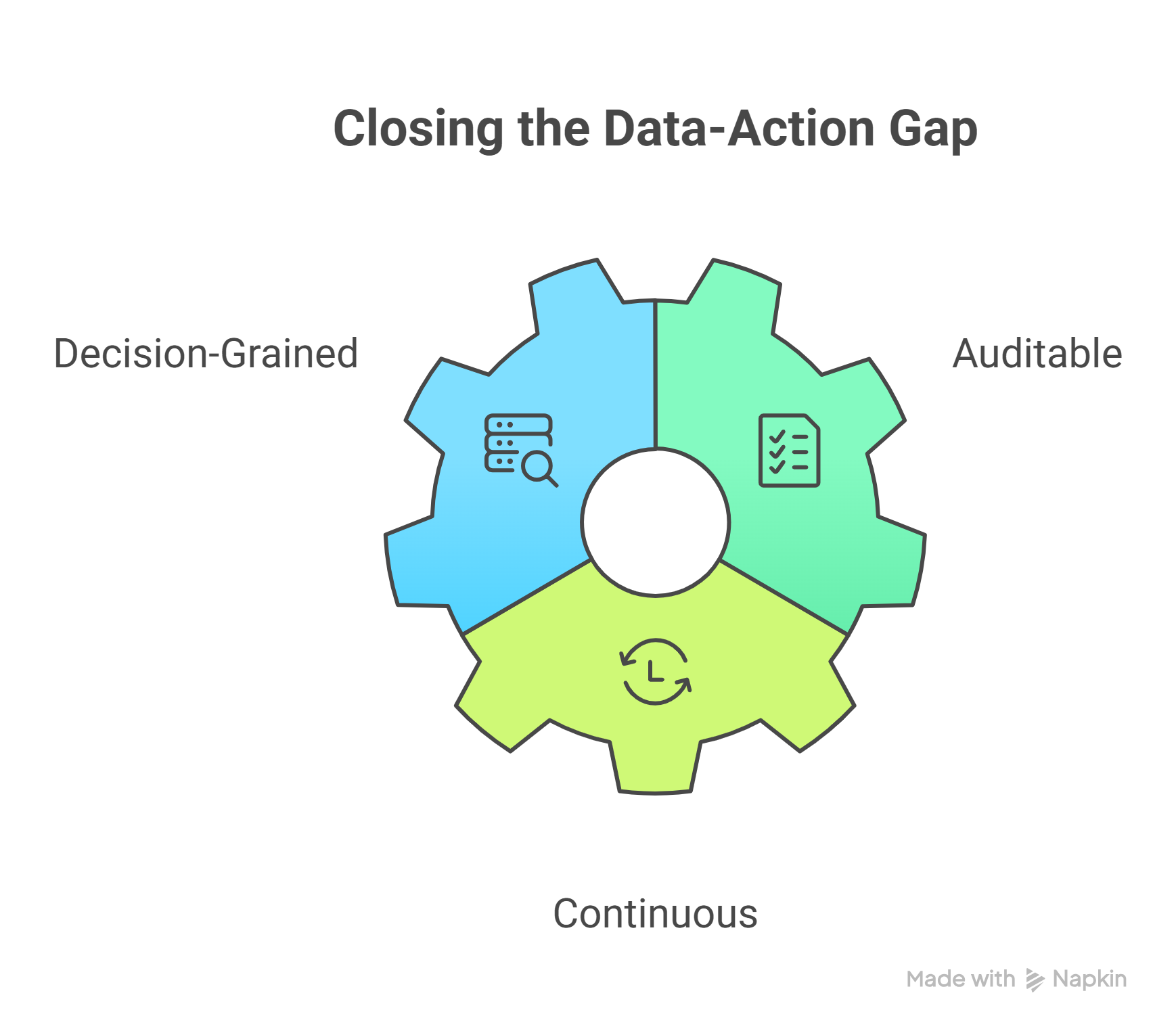
Decision-Grained
The system operates at the granularity of the actual business decision. Not category-level insight, not executive summaries, but specific operational recommendations tied directly to execution.
Auditable
Retail operators must understand why the recommendation exists. Black-box systems consistently fail in operational retail environments because trust is inseparable from adoption. The human must be able to inspect the logic, override the recommendation, and understand the tradeoffs.
Equally important, the system should learn from overrides. If experienced planners consistently reject a recommendation pattern, the workflow itself should evolve. The future is not “human versus machine.” It is operational systems that incorporate human judgment as a continuous feedback signal.
Continuous
Retail business does not operate on quarterly review cycles anymore. Demand shifts hourly, trend signals emerge daily, marketplace dynamics change constantly, inventory risk compounds in real time; the operational cadence of the system must match the cadence of the business and not monthly planning. Continuous adaptation. That architectural shift will define the next generation of retail operations.
Why Fashion, Apparel, and Beauty Make the Problem Harder?
Much of the existing AI commentary in retail breaks down when applied to fashion because fashion retail is structurally different from generalized commerce. The decision surface is far more volatile. New styles launch every season with limited historical data, size curves vary dramatically by geography, demographic, and store cluster, returns rates can exceed 30%, trend signals emerge from TikTok, creators, runway events, weather patterns, celebrity moments, and cultural shifts that move faster than traditional forecasting windows, marketplace channels provide incomplete visibility, wholesale partner data often arrives weeks late, and products themselves have short relevance windows.
A forecasting error in consumer packaged goods might create operational inefficiency. A forecasting error in fashion can destroy full-price sell-through before the season is even halfway complete. This is precisely why generic horizontal AI tooling often underperforms in fashion environments. Most systems were trained around stable replenishment assumptions. Fashion operates closer to probabilistic sensing.
The operational questions are different. Not simply: How much demand exists? But: Which combinations of style, size, location, timing, and channel create the highest probability of profitable sell-through before relevance decays?
That is an entirely different operating problem, and it requires a very different data architecture.
What Changes When the Gap Closes?
The most interesting thing about closing the data-action gap is that the outcome is not primarily productivity, it is leverage. Retail teams spend enormous amounts of time today doing mechanical coordination work, reconciling spreadsheets, checking disconnected systems, validating assumptions, and building reports for decisions that should already exist inside the operational workflow.
When the gap closes, planners spend more time planning, buyers spend more time thinking about next season instead of reconciling last week, markdown strategies become more precise because inventory decisions become more responsive, stockouts decline without bloating inventory, and customer experiences become more relevant without crossing into surveillance.
Operational teams shift upward toward judgment, creativity, and strategic tradeoffs. The mechanical orchestration layer below them becomes increasingly automated. That is the real transformation; not humans disappearing, rather humans operating with a higher leverage.
The Next Decade of Retail Will Be Defined Here
Retail does not suffer from a lack of information anymore. It suffers from an inability to operationalize information at the speed and granularity the business now requires. And the retailers that solve that problem first will not simply become more efficient. They will operate fundamentally differently from everyone else. The next decade of retail will not be won by the companies with the most data, it will be won by the ones whose data actually decides something.
No matter how complex or futuristic this sounds, it just requires an Intelligent Brain over the current tech stack. Contact us to discuss how Data-Hat AI Team can convert your dashboards into a breathing system!
Frequently Asked Questions
How can the data-action gap in retail help retail teams?
It provides practical guidance for improving planning, forecasting, and execution decisions so teams can reduce stock risk and improve customer outcomes.
Why is AI important for modern retail operations?
AI helps retailers process large, fast-changing datasets and generate better decisions for forecasting, inventory, pricing, and assortment in real time.
How do I get started with Data-Hat AI for this use case?
Start by identifying a high-impact category or process, connect core data sources, and run a focused pilot to measure uplift in forecast accuracy, availability, and margin.