Sold Out by 11:00 on Black Friday. Why That Isn't the Win It Looks Like.

Kshitij Kumar
Chief Data and AI Officer
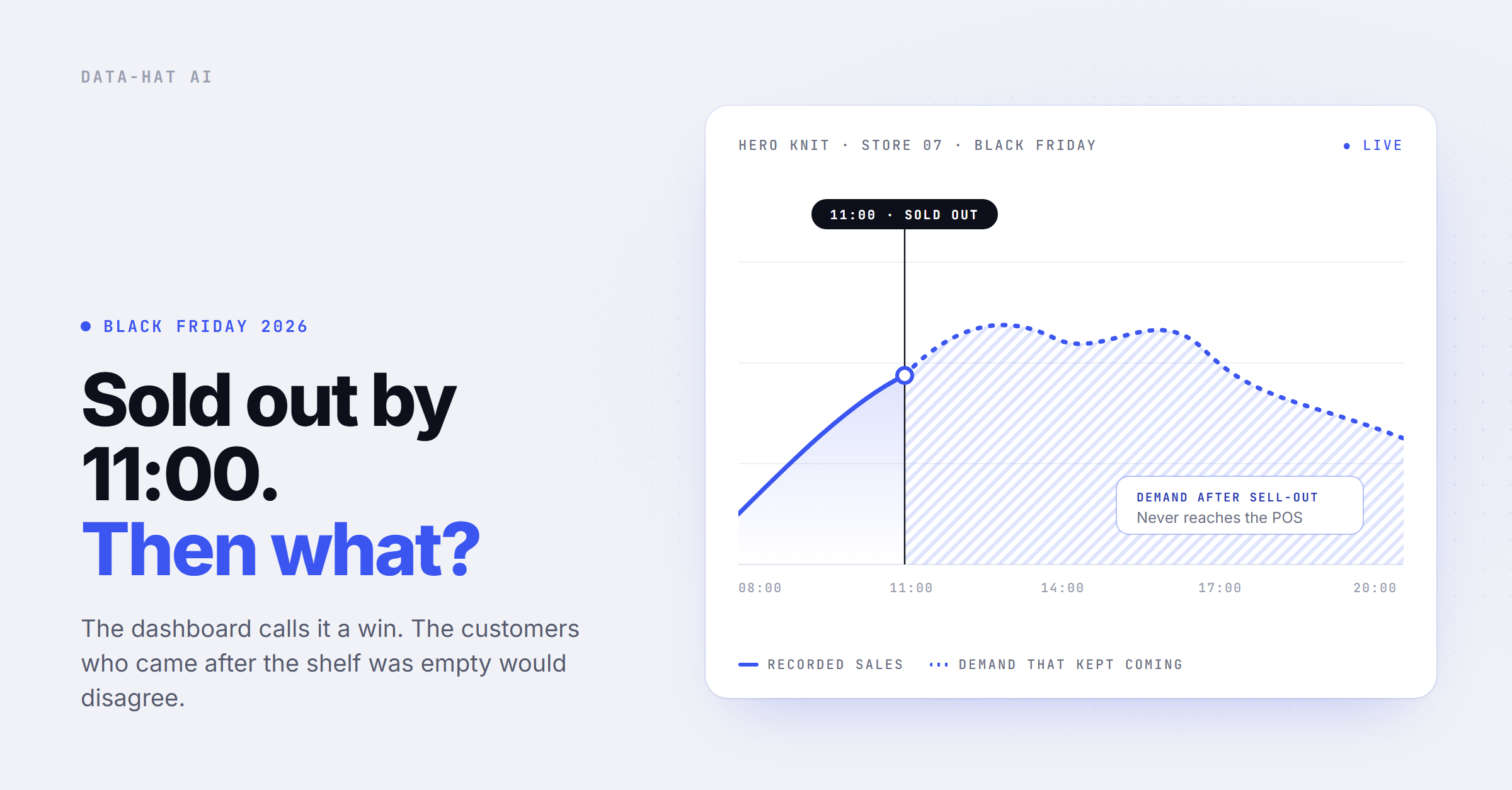
Every year, some version of the same message circulates around a retail head office on Black Friday morning: the hero product sold out by 11:00.
Someone shares a screenshot of the dashboard. Someone else replies with a champagne emoji.
It's understandable. A product selling out before lunch looks like a successful buy, a great campaign and a strong start to the trading weekend.
But what exactly are we celebrating?
A sell-out tells you that you ran out of stock. It doesn't tell you how much demand you satisfied, or how much you missed.
Perhaps you could have sold twice as much. Perhaps the same product was sitting unsold in another store. Perhaps your advertising continued sending customers to a product nobody could buy.
Your dashboard might show a remarkable sell-through performance while the business is simultaneously losing sales, wasting advertising spend and creating future markdowns.
And most retailers wouldn't know the full extent of it.
The difference between selling out and meeting demand
Consider a simple example. A fashion retailer allocates 600 units of a hero knit across 12 stores, 50 units per store.
By 11:00 on Black Friday, six stores have sold out. The other six finish the day with 140 units between them.
The dashboard reports:
- 460 units sold
- 77% sell-through
- Six stores completely sold out
Looks like a good day.
Now imagine that each of the six stores that sold out received another 30 customer requests for the product during the rest of the day.
That's 180 additional expressions of demand that couldn't be fulfilled in those stores.
Not necessarily 180 guaranteed sales. Some customers might have changed their minds, accepted substitutes or bought elsewhere. But they represent valuable demand signals that the sales dashboard alone cannot explain.
Meanwhile, 140 units remain in other stores.
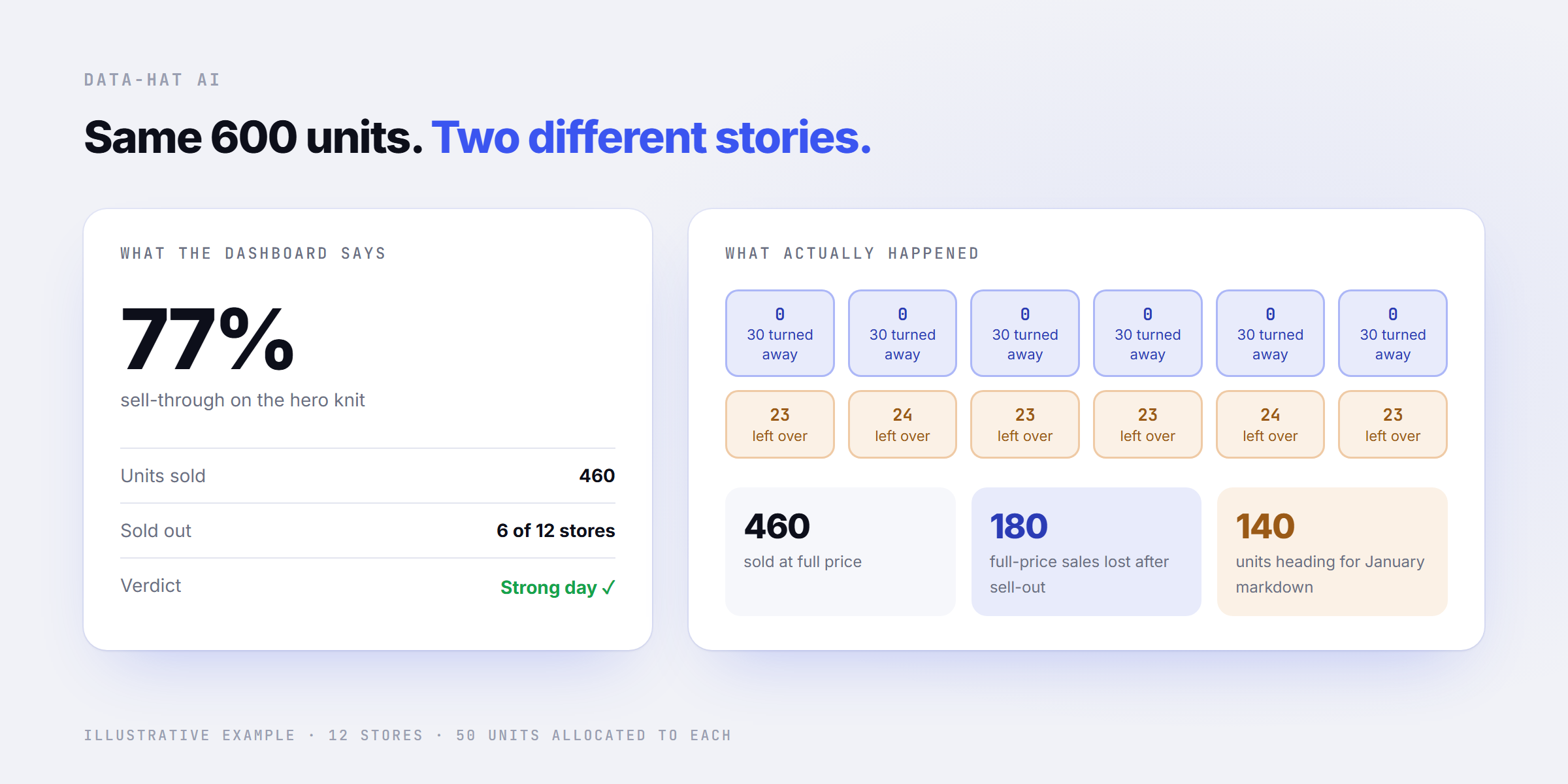
The business now has two problems that may share the same cause: unmet demand in one part of the network and excess stock in another.
Depending on geography, fulfilment capabilities and timing, some of that demand might still be served through another store, online fulfilment or a transfer.
But if nobody captures the demand, nobody can make that decision intelligently.
Sales tell you what customers bought. They don't tell you everything customers wanted.
And that distinction is fundamental to how we should run retail.
Learn more about the Data-Action Gap and How to Solve it
Fill in your details below and our experts will connect with you shortly.
The problem gets built into next year's forecast
The bigger consequence often comes months later.
When the merchandising team builds next year's Black Friday plan, it starts with historical sales.
Those six stores sold 50 units each. The system knows that because 50 units were allocated and 50 were sold.
But if each store had demand for substantially more, the sales history is incomplete.
Statisticians call this censored demand. Sales are constrained by availability, so observed sales can underestimate underlying demand.
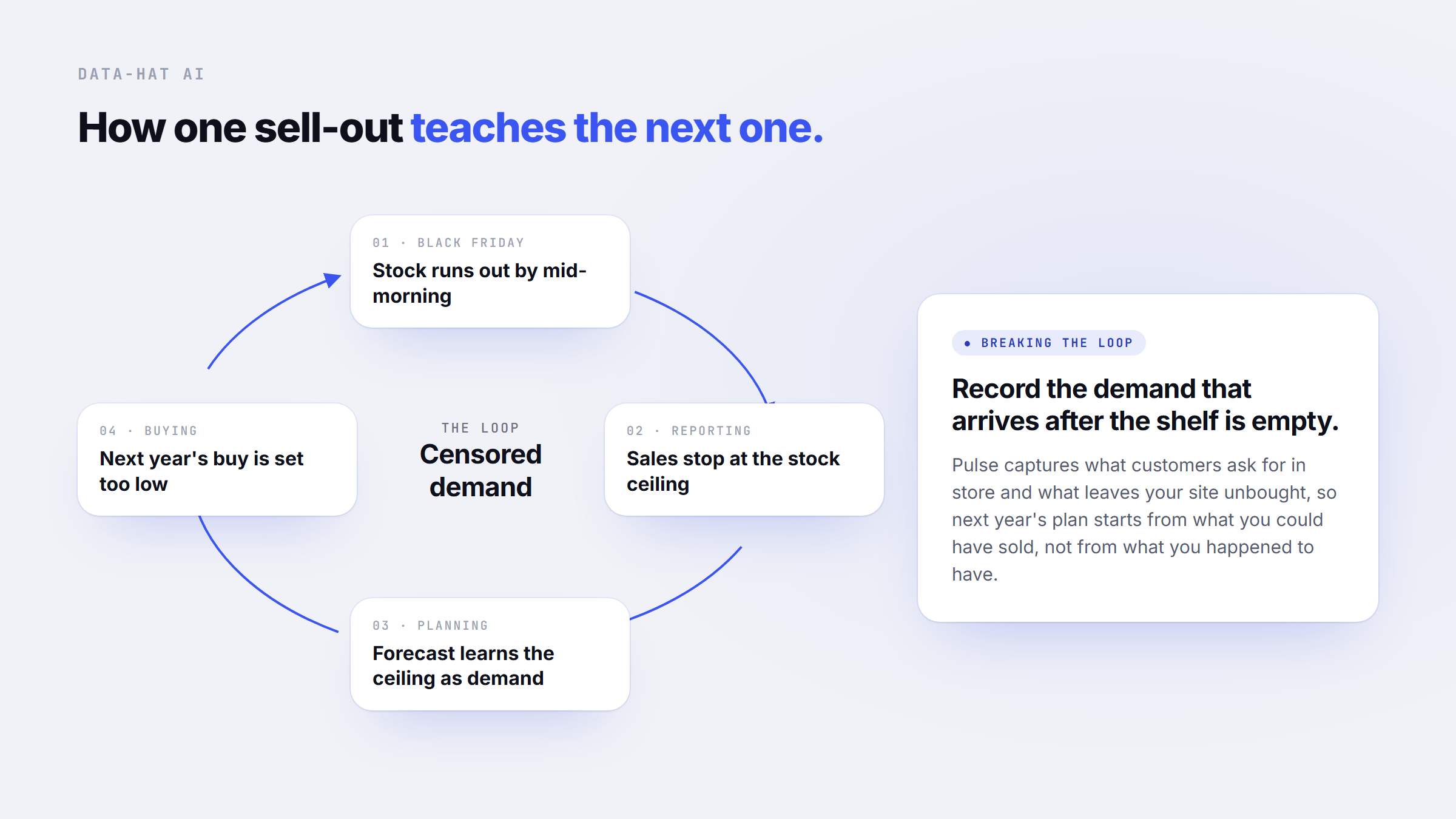
A more sophisticated forecasting algorithm doesn't automatically solve this. If it learns from sales without properly accounting for stockouts and other constraints, it may simply reproduce the historical allocation mistake.
Next year, the retailer could again buy too little for the stores where demand is strongest and too much for stores where demand is weaker.
The industry invests heavily in demand forecasting. Yet much of that forecasting still relies on an imperfect measure of demand: what actually sold.
What customers wanted but couldn't buy is often missing.
The answer isn't simply better forecasting. It's better demand intelligence feeding the forecast.
Black Friday exposes a much bigger retail problem
Black Friday is an extreme example of something happening in retail every day.
A customer sees an advertisement for a jacket, clicks through and discovers their size is unavailable.
Another visits a beauty counter looking for a particular foundation shade, but the store doesn't carry it.
A third searches for a product online, examines alternatives and leaves because none meets their requirements.
In each case, the customer has given the retailer useful information.
But where does it go?
The advertising platform records a click. The website records a session. The inventory system records availability. The store associate remembers the conversation.
None necessarily creates a complete picture of the demand the retailer failed to fulfil.
And if that picture doesn't exist, how can the business know whether it should:
- Change its advertising to promote products it can fulfil?
- Move stock between stores?
- Adjust its assortment or replenishment?
- Change an offer or price?
- Buy or produce more of a product next season?
These decisions are usually made by different teams, working from different data, often weeks apart.
Yet they are responding to the same underlying question.
What do our customers actually want, and what is stopping us from giving it to them?
Five weeks before Black Friday: what can you still change?
Black Friday falls on November 27 this year.
Most retailers have already committed to their seasonal buying decisions. But there is still time to change how they understand demand and how they respond to it.
Three things matter.
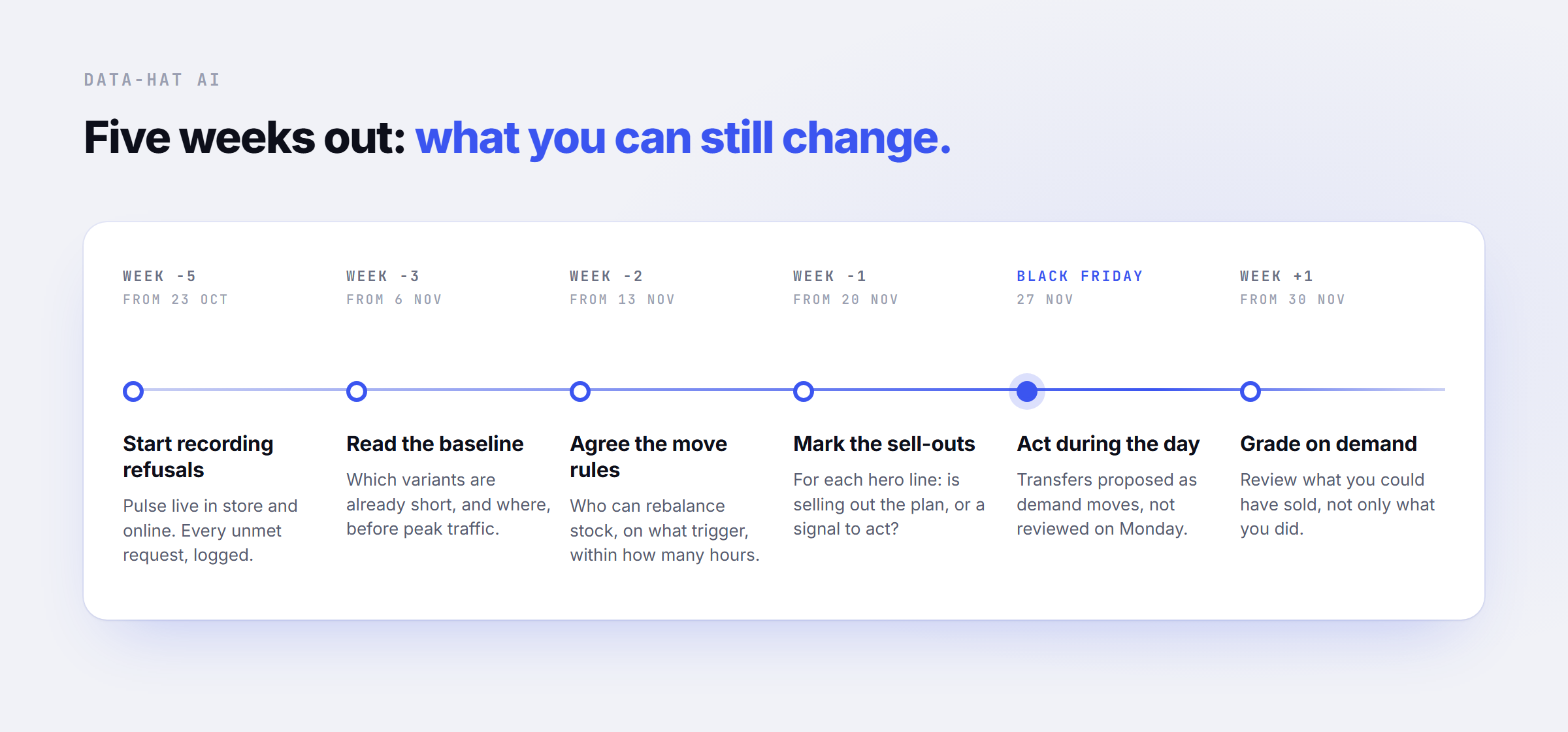
1. Start measuring what customers want, not only what they buy
Don't wait until Black Friday to discover which products, sizes and shades customers can't find.
Start capturing those signals now.
In stores, advisors already hear unmet requests every day. They know which products customers repeatedly ask for and which alternatives customers reject.
Online, searches, product interactions, stock availability and customer journeys offer additional clues.
This is what we are building with Pulse at Data-Hat AI.
Pulse brings together demand signals from stores and digital channels to help retailers understand what customers wanted, including the demand that never reaches the point of sale.
2. Decide in advance who can move stock, and how fast
During peak trading, the gap between knowing and acting is usually measured in days. Someone spots the imbalance on Saturday, raises it on Monday, a transfer is approved on Tuesday and lands on Thursday, after the moment has passed. The insight was correct. It was simply late.
Agree the rules before the weekend. Which lines can be rebalanced between stores without a meeting? What threshold triggers a move? Who signs off, and within how many hours? This is the work Orkestra's Cockpit is built for: it reads the demand profile of every store, proposes transfers as the day unfolds, and turns a cross-team escalation into a decision someone can approve in minutes.
3. Choose what's allowed to sell out
Not every sell-out is a failure. A limited drop that clears in an hour may be the whole point. The problem is the sell-out nobody chose. Go through your Black Friday hero lines and mark each one: is selling out acceptable here, or is it a signal to act? That single column changes how the weekend gets reviewed, and stops the champagne emoji from landing on the wrong result.
Grade Black Friday on what you could have sold
When the weekend is over, add one number to the review, next to revenue and sell-through: the demand you didn't serve. By store, by product, by variant, in store and online. It's the number that tells you whether an 11:00 sell-out was a triumph or a warning, and it's the only honest place to start next year's buy.
Retailers who go into 2027 planning with that number will buy differently, allocate differently, and run out less often in the places that matter. Those who don't will plan from this year's ceiling, and celebrate the same sell-out again next November.
If you'd like to see what that number could look like for your business before the weekend, book a Black Friday Demand Review. It takes 20 minutes and needs no data access. Or see how Pulse works in store and online.
Frequently Asked Questions
Is selling out on Black Friday a good thing?
Sometimes, if the line was meant to sell out. More often an early sell-out means a store received too little stock, customers kept arriving after the shelf was empty, and full-price sales were lost while the same product sat unsold in other stores.
What is censored demand in retail?
Censored demand is what happens when sales data is capped by available stock. If a store sells all 50 units it received, the record shows 50, even if 80 customers wanted the product. Forecasts trained on that history underestimate demand and repeat the stockout.
How can retailers prepare for Black Friday in the final weeks?
Start recording unmet customer requests in store and online now, so you have a baseline before peak traffic. Agree in advance who can move stock between stores and how fast, and decide which hero lines are allowed to sell out and which should trigger action.
How does Pulse help during Black Friday?
Pulse captures the demand that never reaches the POS: requests customers make in store that can't be fulfilled, and demand that leaves your e-commerce site without converting. On the day, it shows how much demand continued after a sell-out. Afterwards, it lets you grade the weekend on what you could have sold.